Accessibility helps people participate more fully in everyday life, from working and traveling to connecting with their communities. It also shapes what people can do within the place where each day begins and ends: home.
The Americans with Disabilities Act established a broad civil rights framework protecting people with disabilities from discrimination in many areas of public life. Its passage helped advance a national understanding that access and inclusion are shared responsibilities, not challenges that individuals should have to navigate alone.
At Home Builders Foundation, that commitment to greater access takes shape inside people’s homes. Through accessible home modifications, we help individuals and families with disabilities move through their daily routines with greater safety, mobility, and independence.
What Is the Americans with Disabilities Act?
The Americans with Disabilities Act, commonly known as the ADA, is a federal civil rights law that prohibits discrimination against people with disabilities. President George H. W. Bush signed it into law on July 26, 1990, following a long history of advocacy led by people with disabilities and the broader disability rights movement.
The ADA addresses access and discrimination across several important areas of public life, including:
- Employment
- State and local government programs and services
- Public transportation
- Businesses and nonprofit organizations that serve the public
- Telecommunications
The law also establishes accessibility requirements for covered public accommodations, commercial facilities, and state and local government facilities.
These protections have helped make accessibility an essential consideration in workplaces, government programs, transportation systems, businesses, and community spaces across the country.
Does the ADA Apply to Private Homes?
The ADA is sometimes described as a general standard for all accessible buildings, but its reach is more specific. The law primarily applies to employment, government services and facilities, transportation, public accommodations, commercial facilities, and telecommunications. Purely private residential settings generally are not covered by Title III of the ADA.
Housing rights and accessibility can be governed by other federal laws, including the Fair Housing Act. That law prohibits disability discrimination in housing and establishes accessibility requirements for certain multifamily housing. It may also protect a resident’s right to request reasonable accommodations or modifications, depending on the circumstances.
This distinction is important: the ADA created critical protections in public life, but it does not automatically remove the physical barriers that may exist inside an individual’s private home.
Why Accessible Home Modifications Matter
A home should support the person who lives there. Yet steps at an entrance, narrow doorways, inaccessible bathrooms, or other physical barriers can make everyday routines more difficult for someone experiencing mobility challenges.
Accessible home modifications are designed around an individual’s needs and the way they use their space. Depending on the home and the person, a project may include:
- An entrance ramp or railing
- A widened doorway
- Bathroom accessibility updates
- Safer or more accessible flooring
- Other modifications that improve mobility and access
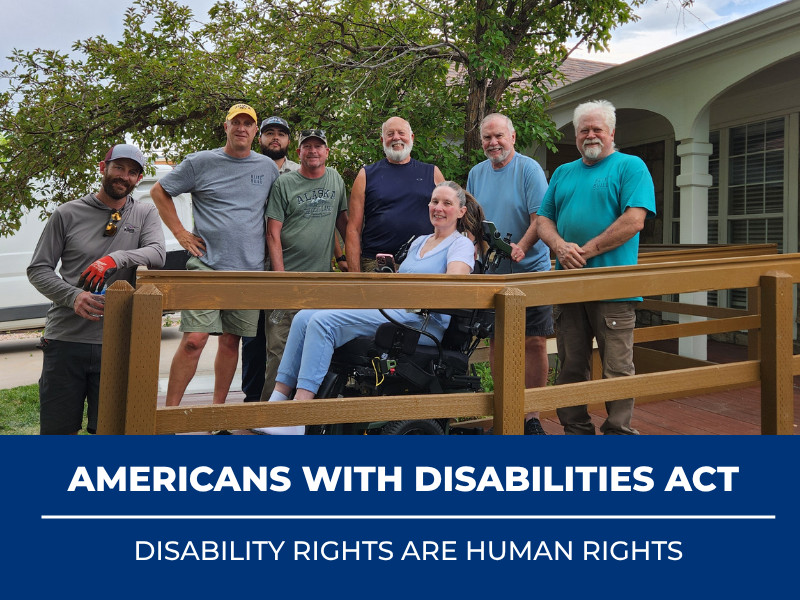
Home Builders Foundation completes ramp, railing, bathroom, flooring, and door-widening projects for individuals with mobility challenges. Each modification is intended to help the individual move through their home more safely and independently.
These projects are not about creating a one-size-fits-all version of accessibility. They are about listening, understanding what is needed, and creating a functional solution designed with the individual—not simply for them.
Building Independence in Metro Denver
Home Builders Foundation designs and builds independence for individuals and families with disabilities in the eight-county Denver metro area. Our home modifications enable greater access, mobility, and safety while helping people remain connected to their homes and communities.
This work complements the larger vision advanced by the ADA: a community in which people with disabilities have greater access, opportunity, and freedom to participate on their own terms.
Donors, volunteers, builders, remodelers, tradespeople, and community partners all help make these projects possible. Financial gifts help fund essential modifications, while donated materials and professional expertise help reduce project expenses and extend the impact of every contribution.
Your support turns obstacles into open doors.
Continuing the Work of Access and Inclusion
The Americans with Disabilities Act established vital legal protections, but creating truly accessible communities requires ongoing participation. Laws can protect rights and set standards. Neighbors, organizations, volunteers, and supporters help bring access to life in the places where people live every day.
When you support an accessible home modification, you help create more than a safer entrance or bathroom. You help build greater independence, dignity, and opportunity for an individual or family in our community.
Because you can’t feel at home unless you feel safe.
Help Build a More Accessible Community
There are several ways to help individuals and families with disabilities experience greater safety and independence at home:
- Volunteer with us: Share your time, skills, or building expertise.
- Refer someone for assistance: Help connect an individual or family with accessible home modification resources.
- Make a donation: Help fund ramps, grab bars, bathroom updates, and other essential modifications.
Together, we can build homes that support fuller, more independent lives.
Source
- ADA.gov — Introduction to the ADA
- ADA.gov — Americans with Disabilities Act law and regulations
- National Archives — Americans with Disabilities Act history
- National Park Service — Disability Rights Movement
- National Council on Disability — Equality of Opportunity: The Making of the Americans with Disabilities Act
- U.S. Department of Justice — ADA applicability to private residential settings
- U.S. Department of Housing and Urban Development — Disability rights and housing
- HUD and U.S. Department of Justice — Reasonable Modifications Under the Fair Housing Act